
Portable Pump in a Brewery
- Dec 15, 2025
- 135
- tiantai
Portable Pump Introduction
Portable pump in a brewery can bring significant advantages, especially in terms of flexibility, efficiency, and cleaning. Here’s a breakdown of how to introduce a portable pump into a brewery setup and the potential benefits:
- Assessing Brewery Needs
Purpose: Determine the specific needs of the brewery for using a portable pump. Common uses in brewing include transferring liquids (wort, beer etc.) between vessels, filtering, or cleaning.
Flow Rates: We supply suitable pump to match flow rate for your brewery’s typical batch sizes. The pump should be capable of moving liquid with the desired speed and consistency.
- Types of Pumps
Centrifugal Pumps: Common in larger breweries for high-volume, fast transfers. These pumps work best for moving larger volumes of liquid at lower pressure.
- Flexible Hose and Connections
Our portable pump has quick-connect fittings to allow for easy setup and removal.
Use food-grade, flexible hoses that are durable and resistant to high temperatures and pressure.
- Ease of Cleaning
Since hygiene is critical in brewing, look for a portable pump that is easy to disassemble and clean. Our pumps are designed to be CIP (Clean In Place) compatible.
After each use, thoroughly clean the pump to avoid contamination and ensure longevity.
- Safety Considerations
Properly secure the pump to prevent spills or accidents, especially when handling hot liquids or under pressure.
- Flexibility and Mobility
The main advantage of a portable pump is mobility, so choose one with an ergonomic design that allows easy transportation and storage. Our pump is easy to maneuver, and with powerful enough to handle the workload.
- Integration with Existing Systems
It can be easily integrated into your brewery’s existing setup, such as through adaptable tubing or quick-connect fittings to fermenters, mash tuns, and kettles.
- Cost and Efficiency
The pump cost is reasonable, with expected increase in efficiency and labor savings. It helps streamline operations and reduce the time spent transferring and handling ingredients.
- Training and SOPs
Train the brewing team on how to properly use and maintain the portable pump. Ensure they understand its application, safety protocols, and maintenance requirements.
Once you have our pump, you can experiment with different uses throughout your brewery. Whether you're transferring wort between vessels, cleaning tanks, or even moving yeast, a portable pump can streamline many processes and improve productivity.
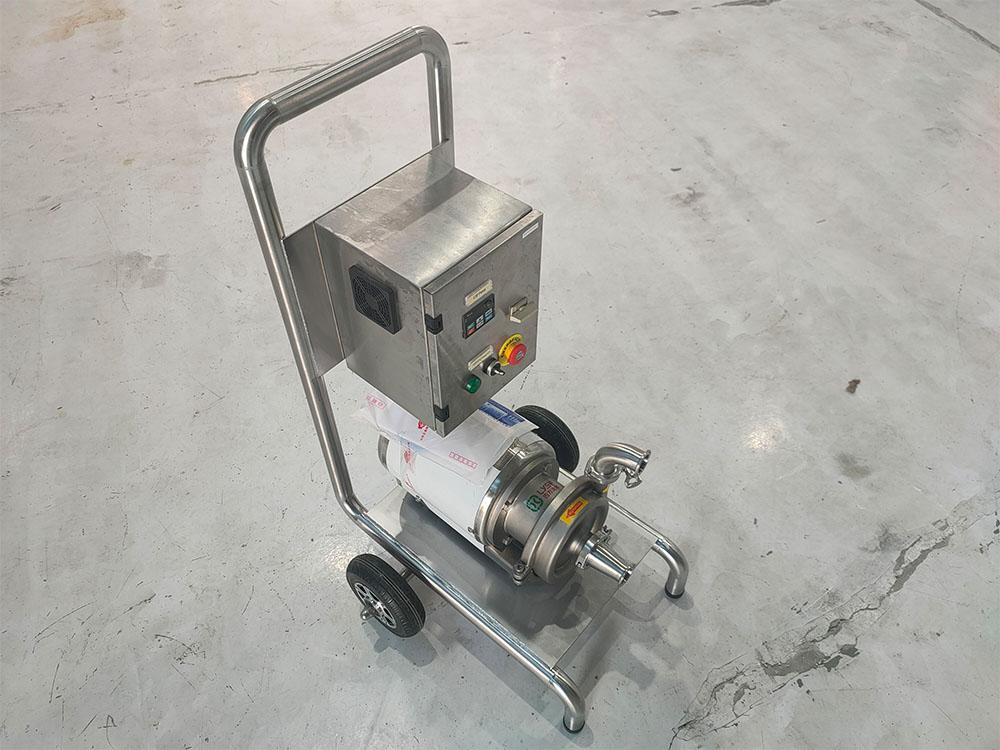
The structure of a portable pump used in a brewery typically consists of several key components that work together to move liquids effectively and efficiently. Here’s a breakdown of the main components:
Portable Pump Structure
- Motor
Function: The motor powers the pump, providing the force needed to move liquid through the system.
Power Source: It can be customized according to site voltage and connect cable to control cabinet
Speed Control: Our portable pump allow speed adjustments to regulate the flow rate of liquids, which is especially useful when transferring delicate liquids like wort or beer.
- Impeller for Centrifugal Pumps
Centrifugal Pumps
The impeller is a rotating device that moves liquid. It spins inside the pump casing, creating a vacuum that sucks liquid into the pump and then forces it out through the outlet.
The impeller design can vary based on the required flow rate and pressure.
- Inlet and Outlet Ports
Inlet Port: Where the liquid enters the pump, typically connected to a hose or pipeline. This is usually where the pump's suction action occurs, drawing in liquid from the source vessel.
Outlet Port: The exit point for the liquid, where it is pushed into the next vessel or pipe. The outlet port can be fitted with a hose or pipe, and sometimes with a valve to control flow.
Both ports are usually designed tri-clamp connections for easy connecting
- Control Panel and Switches
Control Panel: It comes a control panel with VFD to manage motor speed, flow etc.
On/Off Switch: Most pumps have a basic on/off switch to control the pump's operation.
- Base or Frame
Function: The base or frame of a portable pump supports all the components and provides a stable platform for the pump. This is especially important in mobile setups, as it ensures the pump stays steady during operation.
Material: The frame is made of stainless steel. It often includes handles or wheels for easy mobility.
Portability: Our portable pumps are mounted on wheels or equipped with handles for easy movement around the brewery. Some frames include brackets for securing the pump to a surface or cart.
-Gaskets and Seals
Gaskets and seals are critical for maintaining the sanitation and pressure integrity of the pump system. They ensure that there are no leaks, especially when working with hot liquids or under pressure.
Pump Operation
- Opening Box/Delivery
Pay attention to the following items:
1. Eliminate the coating material or covering on the inlet and outlet of the pump
2. Check the pump body to see whether it has obvious shipping damage or not
3. Do not damage the inlet and outlet of the pump
4. If the connection of infusion liquid has already been supplied,make sure that is should not be damaged.
5. If the covering is fixed on the pump before the pump is raised,it should be removed first.
Pay attention to the following items when checking and accepting the goods
1. the pump body is complete and undamaged
2. 2. Delivery list
3. The instruction manual of the Pump
4. The instruction manual of the Motor
-Installation
1. The pump electric wire should be connected by the professional electrician to ensure correction the motor rotation direction.
Pay attention to the following items when installing
2. The best position while installing the pump is below the inhale liquid(if the pump installing position is above the inhale liquid, it should be infused before turning on the pump)
3. Make sure to have enough space around the pump(not less than 0.5 meter)
4. Make sure that the flow way of inlet and outlet is correct
5. Make sure that the pipeline route is correct
6. Prevent the pump body from the compression(vibration, pipeline hot inflationt, much welding, pipeline overload)
1. Inspection before opening the pump
1. Check pump impeller rotation direction is correct or not(according to the rotation direction label), Reverse operation is forbidden.
2. Check the motor cover to prevent the water, damage and electricity.
3. Empty running is forbidden , it must have medium and then can be operation.
4. Make sure that pipe inside is clean and without any other objects medium before opening the pump.
-Operating/Controlling
Usage should follow the technical parameters
1. When sending hot liquid and sterilizing,touching pump or pipeline should not be allowed in order to prevent burning.
2. When clogging of both inlet and outlet happens,operating the pump should not be allowed in order to prevent exploding.
3. The dry running of the shaft should not be allowed.
4. Installing the pressure regulating valve in the inlet of the pump,throttling in the inlet of pump should not be allowed.
5. Don't operate overloadedly for a long time,otherwise the motor will be damaged.
- Cleaning Method
1. Should be extra careful in treating acid fluid and soda fluid,Shall always wear the rubber gloves and protective glass.
2. Touching the pump or tubings is absolutely not allowed to avoid hurt by burning while disinfecting
3. Examples of cleaning fluid composition.
1)At 70℃,1%NaOH:NaOH(1kg)+Water(100L)=Cleaning Fluid
2)At 70℃,0.3%HNO3:53%HNO3(0.7L)+Water(100L)=Cleaning Fluid
4. Cleaning Fluid Composition and Usage:
1)While mixing,all the solutions shall be put in step by step to avoid high concentration
2)To adjust the flow volume during the process(Like milk,viscosity fluid etc,should increase the flow volume)
Attentation
1. After the cleaning,the fluid should be washed out completely by clean water
2. The storage and usage of cleaning water shall comply with the present regulation /instruction strictly
Repair
1. Must follow technical parameters
2. When repairing,should first cut off the power
3. While repairing,do not heat the pump body
4. While repairing,any pressure inside the pump and tubing is forbiden
5. After repairing or maintenance,if the power wires have been taken off the motor,be sure that they are correctly connected as well.
General Repair
| Item | Shaft Seal | Rubber Gasket | Motor Shaft |
| Maintenance | Regular checking | Regular checking | / |
|
Repair after leakage (Starts slowly) |
Replace all the seals right away | Replace with shaft seal | / |
| Planned Repair |
1. Inspection running and leakage on time 2. Record inspection report 3. Arrange inspection acc to record statistics 4. Replace all shaft seals after leakage |
Replace with shaft seal |
1. Suggest annual inspection 2. Replace all the shaft in case they wear out 3. Shaft axially locked |
| Lubrication |
Before installation: Lubricate the O-ring with Silicone oil or grease |
Before installation: Lubricate with Silicone oil or grease |
Long-term lubrication |
Eliminating Trouble
| Pump trouble | The reason caused the trouble | Preventive measure and removing way |
| Motor exceeds load |
1.The viscosity of material conveyed by pump is too high 2. The pressure of exit is too low 3. Sediment gathers in the liquid |
1.Changing a bigger motor or smaller impeller 2. Increasing backpressure (throttling) 3. Washing frequently |
| High quake or noise |
1.Foot screws are too looseness and have different height 2. Principal axis jumpiness |
Adjusting the height,leaving the floor placidly and screwing down the screw cap Changing the principal axis |
| Unstable electric | Unstable Voltage uneven three phase voltage | Checking voltage and adopting the measure of leveling off voltage |
| The leakage of the casing pump casing flange gasket | 1. Gasket is not in the groove 2. The casing pump flange screw is not fastened | Taking apart the pump head and letting the gasket in the seal canal fastening six screws |
|
The leakage of pump mechanical seal |
1. Metal sundries particle enters the surface of the seal and damages the seal of the machine 2. Static ring is not in the pin key of the impeller pedestal,O-ring is not screwed down 3. Before turning on the pump,there is no liquid,the time of racing and reversal is too long,so that seal face is burned out 4. The spring rotating ring is damaged and dropped.The seal has no pressure,before turning on,haven't rotated the principal axis,the surface of seal conglutinates tightly |
1. Before turning on,checking the pump head,purging and changing the mechanical seal 2. Taking apart and letting the static ring in the pin key,impacting into the O-ring. 3.Turning on then turning off,and seeing that if the rotary direction is the same with the rotary direction of the pump,changing the mechanical seal. 4. Before turning on,rotate the prinicpal axis for several times,opening and checking the seal if too tightly,and changing the seal spring or a complete set of seal. |
|
Leakage after changing the new seal |
The way of change is wrong |
Taking apart the chassis,purging every step,blowing the seal static ring cleanly then putting it in the seal canal of,impeller seat,please note that static ring should aim at the pin key,wiping the principal axis cleanly,installing roating ring,screwing down the yoke screw,then installing the impeller and casing pump. |
Technical Specifications
Max.inlet pressure:0.5Mpa
Temperature range:-10℃ to + 140℃ (EPDM)
Noise level(at 1 m):60-80dB(A)
Seal type: Single end mechanical seal
Materials
1. Product wetted steel parts:SUS316L or SUS304 stainless steel
2. Other steel parts:SUS304 stainless steel
3. Auxiliary sealed material:EPDM
4. Machinery sealed material:C一SIC SIC一SIC
Motor
1. These motors are made from WEG brand Standard three phase AC machine. They are built to comply with current international standards:International Electro-technical CommissionI EC60034 and IEC60072,EU directives to fulfill European"CE"marking, UL Certified
2.Superior electric performance,low noise,low quake,All motors are protected to IP55 as a minimum,Insulation level for the motors is F level.
3. Specified voltage and frequency 3~,50Hz,220~240V/380~420V/660~690 V,△/Y
4. Power1.1、1.5、2.2、3、4、5.5、7.5、11、 15、18.5、22、30、45、55kw
5. Speed of rotationThe speed of rotation for standard pump is 2900rpm
Surface treatment
Product wetted part:bright 0.4mm,other parts:sandblasting or semi bright
For more details, kindly contact us to get your professional proposal.
Derrick
Sales Manager
[email protected]
Tiantai Beer Equipment

.jpg)
