
Why a Buffer Tank Makes the Difference in Continuous Brewing
- Jun 06, 2026
- 177
- tiantai
Why a Buffer Tank Makes the Difference in Continuous Brewing: Four-Vessel vs Five-Vessel Brewhouse Systems
In modern craft and industrial brewery, efficiency, consistency, and scalability are more important than ever. While traditional batch brewing processes have served brewers for decades, the growing demand for high-quality beer and increased production capacity has pushed brewery to adopt continuous brewing solutions. One key innovation that distinguishes continuous brewhouses from conventional systems is the buffer tank placed between the Lauter Tun and the Brew Kettle. In this article, we explore why this vessel is so critical, and why it defines the difference between a four-vessel and a five-vessel brewhouse system.
I. Understanding the Traditional Four-Vessel Brewhouse System
A four-vessel mash system consists of the following core units:
* Mash Tun – for starch conversion
* Lauter Tun – for wort separation
* Brew Kettle – for wort boiling, hopping, and evaporation
* Whirlpool Tun – for trub separation and wort clarification
In this configuration, each vessel is tightly coupled with the next. Wort produced in the mash tun and lautering stage flows directly into the brew kettle, and no intermediate storage exists. While this design works efficiently for batch production, it comes with several limitations:
- The brew kettle must wait until the lautering process is complete before boiling can begin.
- Any delay or inconsistency in the lautering stage directly impacts the kettle operation.
- The brewhouse system is inherently batch-dependent, which limits the number of brews per day and reduces overall throughput.
For breweries aiming to scale production or maintain a continuous brewing schedule, these limitations can result in downtime, lower efficiency, and inconsistent wort quality.
II. The Role of the Buffer Tank in Continuous Brewing
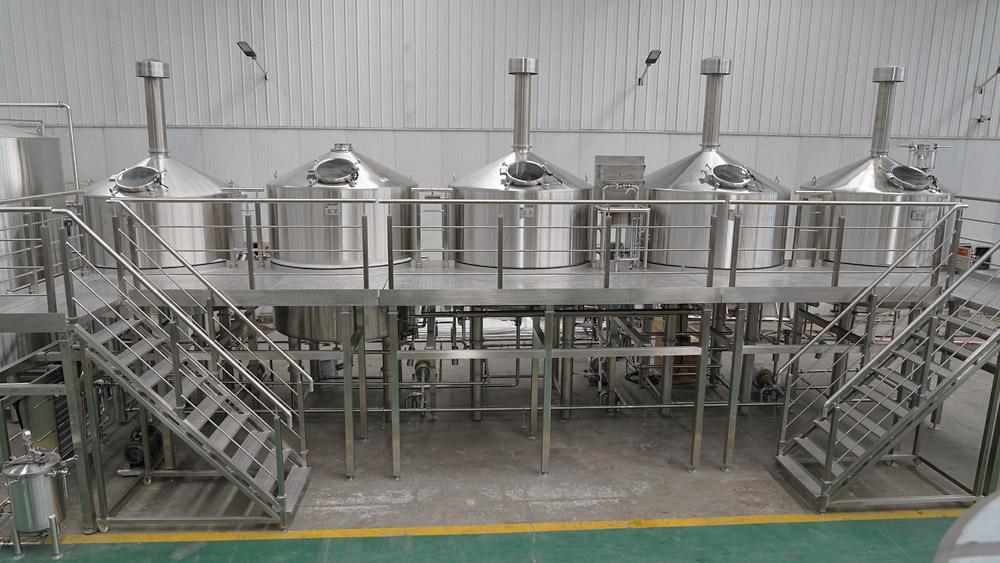
Introducing a buffer tank between the Lauter Tun and the Brew Kettle transforms the system into a five-vessel brewhouse system. This seemingly simple addition has profound effects on brewing operations.
Key Functions of the Buffer Tank:
1. Decoupling Process Steps:
The buffer tank allows lautering and boiling to operate independently. While one batch is being boiled in the kettle, the next batch can already be lautered and temporarily stored in the buffer tank. This eliminates idle time and ensures that each vessel can operate continuously at optimal efficiency.
2. Stabilizing Wort Flow:
Continuous breweries require a steady wort feed to the kettle. The buffer tank acts as a stabilizer, evening out fluctuations in flow from the lautering tun. This results in a more consistent boiling process, improved hop utilization, and uniform wort quality.
3. Facilitating High Throughput:
With a buffer tank, breweries can increase production cycles per day. Tiantai’s 8000L five-vessel brewhouse, for example, can handle up to 8 batches per day, compared to fewer cycles in a traditional four-vessel system. This directly enhances plant utilization and overall output.
4. Providing Process Flexibility:
The buffer tank allows for adjustments in batch timing without disrupting downstream processes. For breweries producing multiple beer styles, this flexibility is critical to managing recipes and scheduling production efficiently.
5. Improving Automation and Control:
In modern PLC-controlled brewhouses, sensors and automation rely on predictable flows. The buffer tank smooths variations in wort volume, pressure, and density, making automated pumping, flow control, and CIP cleaning more reliable.
III. Comparing Four-Vessel and Five-Vessel Brewhouse Systems
The comparison clearly shows that adding a buffer tank transforms the brewhouse from a batch-oriented system into a continuous, high-efficiency production line. For breweries looking to increase throughput without compromising quality, the five-vessel design is a practical and strategic investment.
IV. Industrial Advantages of a Five-Vessel Brewhouse
* Maximized Productivity:
By decoupling lautering and boiling, breweries can schedule overlapping processes, reducing downtime and increasing daily output.
* Enhanced Beer Quality:
Stable wort flow reduces foam formation, hop loss, and variability in extract content, resulting in more consistent beer.
* Automation Compatibility:
The buffer tank supports PLC-based control systems, integrating sensors such as flow meters, pH probes, turbidity meters, foam detectors, and level switches. This allows for precise monitoring and reduced manual intervention.
* Operational Safety and Hygiene:
With automated CIP systems, the buffer tank can be cleaned in place along with other vessels, maintaining sanitary conditions while minimizing labor requirements.
* Future-Proof Design:
Breweries can start with a four-vessel system and add a buffer tank later to convert to five-vessel operation, allowing gradual scaling as demand grows.
V. Why Tiantai Beer Equipment Company Chooses the Buffer Tank Design
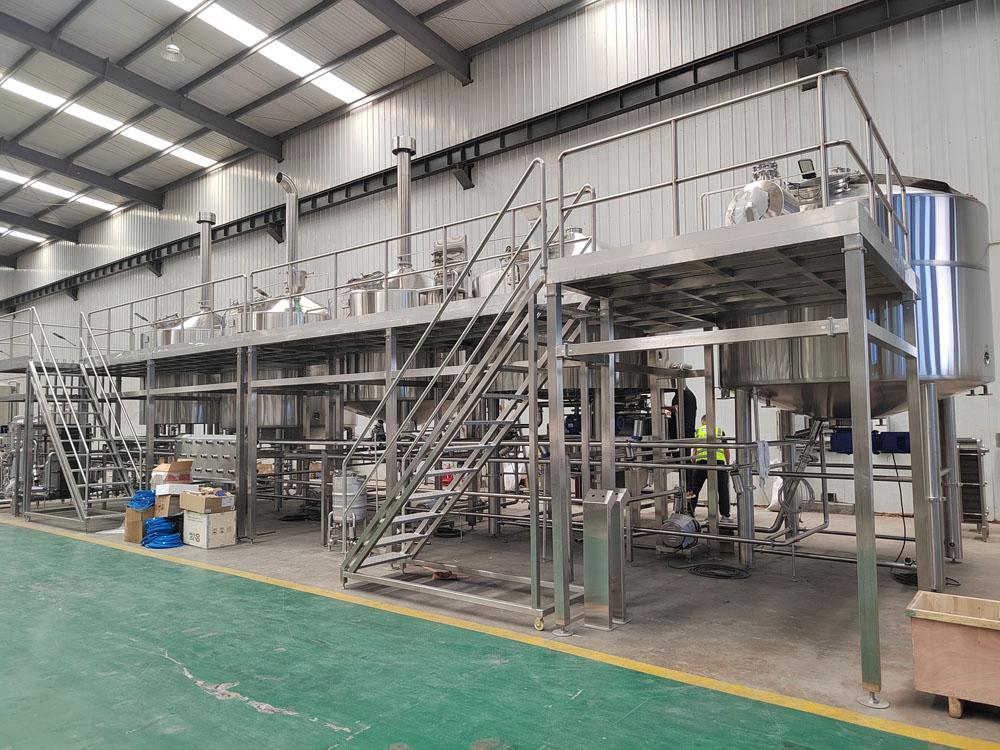
At Tiantai, we focus on engineering solutions that combine efficiency, reliability, and scalability. Our five-vessel brewhouse exemplifies this philosophy:
- Continuous Production: Multiple batches can be processed per day without idle time.
- Process Optimization: Each vessel operates independently but in sync, stabilized by the buffer tank.
- Automation Ready: Full integration with PLC, touchscreens, pneumatic valves, and advanced sensors ensures smooth operation.
- CIP Compatibility: The buffer tank is fully incorporated into the automated cleaning process, ensuring hygienic operations without downtime.
This approach ensures that breweries adopting Tiantai’s five-vessel system achieve maximum output, stable quality, and operational flexibility, all while reducing manual labor and risk of process errors.
In modern brewing, the difference between a four-vessel brewhouse system and a five-vessel brewhouse system with a buffer tank is more than just an extra piece of equipment—it represents a strategic upgrade in process efficiency, product quality, and scalability. By decoupling lautering and boiling stages, the buffer tank enables continuous brewing, consistent wort quality, and seamless automation integration.
Breweries looking to expand production or transition to a high-efficiency, automated brewing line will find the five-vessel mash system to be a smart and forward-looking investment.
VI. Contact Tiantai Beer Equipment Company
Ready to take your brewery to the next level? Tiantai Beer Equipment Company provides customized five-vessel brewhouse solutions, complete with continuous brewing capability, advanced automation, and integrated CIP cleaning. Contact us today to request a detailed quotation and technical consultation. Let us help you build a brewery that operates continuously, efficiently, and with consistent quality.
In modern craft and industrial brewery, efficiency, consistency, and scalability are more important than ever. While traditional batch brewing processes have served brewers for decades, the growing demand for high-quality beer and increased production capacity has pushed brewery to adopt continuous brewing solutions. One key innovation that distinguishes continuous brewhouses from conventional systems is the buffer tank placed between the Lauter Tun and the Brew Kettle. In this article, we explore why this vessel is so critical, and why it defines the difference between a four-vessel and a five-vessel brewhouse system.
I. Understanding the Traditional Four-Vessel Brewhouse System
A four-vessel mash system consists of the following core units:
* Mash Tun – for starch conversion
* Lauter Tun – for wort separation
* Brew Kettle – for wort boiling, hopping, and evaporation
* Whirlpool Tun – for trub separation and wort clarification
In this configuration, each vessel is tightly coupled with the next. Wort produced in the mash tun and lautering stage flows directly into the brew kettle, and no intermediate storage exists. While this design works efficiently for batch production, it comes with several limitations:
- The brew kettle must wait until the lautering process is complete before boiling can begin.
- Any delay or inconsistency in the lautering stage directly impacts the kettle operation.
- The brewhouse system is inherently batch-dependent, which limits the number of brews per day and reduces overall throughput.
For breweries aiming to scale production or maintain a continuous brewing schedule, these limitations can result in downtime, lower efficiency, and inconsistent wort quality.
II. The Role of the Buffer Tank in Continuous Brewing
Introducing a buffer tank between the Lauter Tun and the Brew Kettle transforms the system into a five-vessel brewhouse system. This seemingly simple addition has profound effects on brewing operations.
Key Functions of the Buffer Tank:
1. Decoupling Process Steps:
The buffer tank allows lautering and boiling to operate independently. While one batch is being boiled in the kettle, the next batch can already be lautered and temporarily stored in the buffer tank. This eliminates idle time and ensures that each vessel can operate continuously at optimal efficiency.
2. Stabilizing Wort Flow:
Continuous breweries require a steady wort feed to the kettle. The buffer tank acts as a stabilizer, evening out fluctuations in flow from the lautering tun. This results in a more consistent boiling process, improved hop utilization, and uniform wort quality.
3. Facilitating High Throughput:
With a buffer tank, breweries can increase production cycles per day. Tiantai’s 8000L five-vessel brewhouse, for example, can handle up to 8 batches per day, compared to fewer cycles in a traditional four-vessel system. This directly enhances plant utilization and overall output.
4. Providing Process Flexibility:
The buffer tank allows for adjustments in batch timing without disrupting downstream processes. For breweries producing multiple beer styles, this flexibility is critical to managing recipes and scheduling production efficiently.
5. Improving Automation and Control:
In modern PLC-controlled brewhouses, sensors and automation rely on predictable flows. The buffer tank smooths variations in wort volume, pressure, and density, making automated pumping, flow control, and CIP cleaning more reliable.
III. Comparing Four-Vessel and Five-Vessel Brewhouse Systems
| Feature | Four-Vessel Brewhouse System | Five-Vessel Brewhouse System (with Buffer Tank) |
| Process Flow | Batch-dependent, tightly coupled | Decoupled, continuous-friendly |
| Brew Kettle Idle Time | High; must wait for lautering | Minimal; kettle can boil while lautering continues |
| Number of Batches per Day |
Limited |
Increased; can reach up to 8 batches/day (depending on size) |
| Wort Quality Consistency | Moderate; fluctuations affect kettle | High; buffer stabilizes flow and density |
| Automation Complexity | Lower, but less flexible | Higher, but optimized with PLC, sensors, and flow control |
| Scalability | Limited by batch timing | High; easier to expand or upgrade production |
| CIP Efficiency | Simple, batch-based | Automated CIP can circulate through buffer and kettle simultaneously |
| Operational Flexibility | Low | High; supports multiple recipes and continuous scheduling |
The comparison clearly shows that adding a buffer tank transforms the brewhouse from a batch-oriented system into a continuous, high-efficiency production line. For breweries looking to increase throughput without compromising quality, the five-vessel design is a practical and strategic investment.
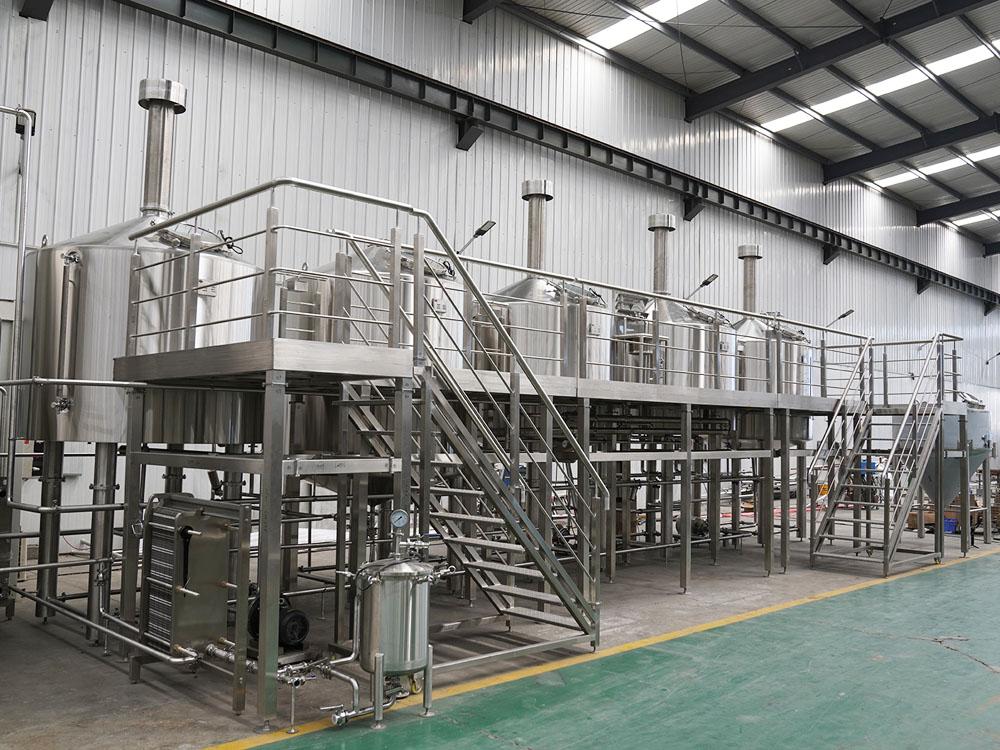
IV. Industrial Advantages of a Five-Vessel Brewhouse
* Maximized Productivity:
By decoupling lautering and boiling, breweries can schedule overlapping processes, reducing downtime and increasing daily output.
* Enhanced Beer Quality:
Stable wort flow reduces foam formation, hop loss, and variability in extract content, resulting in more consistent beer.
* Automation Compatibility:
The buffer tank supports PLC-based control systems, integrating sensors such as flow meters, pH probes, turbidity meters, foam detectors, and level switches. This allows for precise monitoring and reduced manual intervention.
* Operational Safety and Hygiene:
With automated CIP systems, the buffer tank can be cleaned in place along with other vessels, maintaining sanitary conditions while minimizing labor requirements.
* Future-Proof Design:
Breweries can start with a four-vessel system and add a buffer tank later to convert to five-vessel operation, allowing gradual scaling as demand grows.
V. Why Tiantai Beer Equipment Company Chooses the Buffer Tank Design
At Tiantai, we focus on engineering solutions that combine efficiency, reliability, and scalability. Our five-vessel brewhouse exemplifies this philosophy:
- Continuous Production: Multiple batches can be processed per day without idle time.
- Process Optimization: Each vessel operates independently but in sync, stabilized by the buffer tank.
- Automation Ready: Full integration with PLC, touchscreens, pneumatic valves, and advanced sensors ensures smooth operation.
- CIP Compatibility: The buffer tank is fully incorporated into the automated cleaning process, ensuring hygienic operations without downtime.
This approach ensures that breweries adopting Tiantai’s five-vessel system achieve maximum output, stable quality, and operational flexibility, all while reducing manual labor and risk of process errors.
In modern brewing, the difference between a four-vessel brewhouse system and a five-vessel brewhouse system with a buffer tank is more than just an extra piece of equipment—it represents a strategic upgrade in process efficiency, product quality, and scalability. By decoupling lautering and boiling stages, the buffer tank enables continuous brewing, consistent wort quality, and seamless automation integration.
Breweries looking to expand production or transition to a high-efficiency, automated brewing line will find the five-vessel mash system to be a smart and forward-looking investment.
VI. Contact Tiantai Beer Equipment Company
Ready to take your brewery to the next level? Tiantai Beer Equipment Company provides customized five-vessel brewhouse solutions, complete with continuous brewing capability, advanced automation, and integrated CIP cleaning. Contact us today to request a detailed quotation and technical consultation. Let us help you build a brewery that operates continuously, efficiently, and with consistent quality.
.jpg)

