
Brewery Grain Mills vs Distillery Grain Mills: Key Differences in Barley Milling
- May 22, 2026
- 180
- tiantai
Grain milling is one of the most important steps in both brewing and distilling. The way barley or other grains are crushed directly affects starch conversion efficiency, filtration performance, and fermentation results. However, breweries and distilleries use different types of grain mills because their production goals are different. Breweries typically prefer roller mills, while many distilleries use claw mills or hammer-style mills for finer grinding. Interestingly, although roller mills are common in breweries, claw mills are often more expensive due to their stronger structure, higher power requirements, and heavy-duty design.
This article explains the key differences between brewery grain mills and distillery grain mills, including their working principles, advantages, and typical applications.
Grain Milling in Breweries
Typical Mill Type: Roller Mill
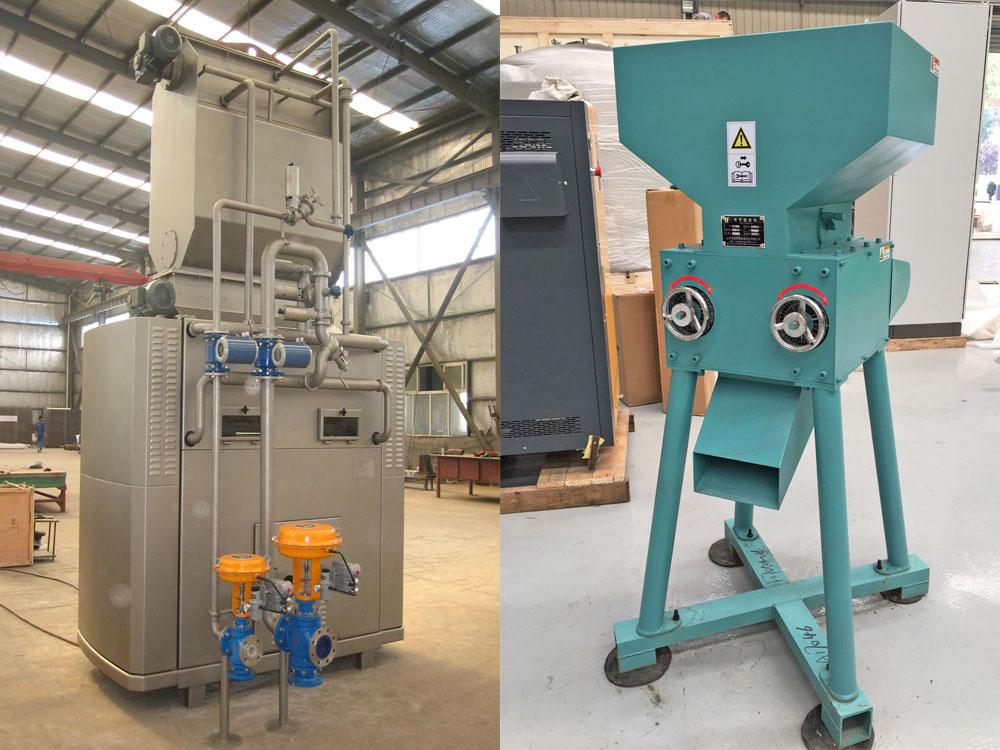
Most breweries use two-roller or four-roller mills to crush malted barley.
The principle of a roller mill is simple: two rollers rotate toward each other and gently crack the grain kernel. The goal is not to completely pulverize the grain but to break the kernel while preserving the husk.
Typical particle size after milling: 1.2 mm – 2 mm
Why Breweries Use Roller Mills
In beer production, the milled grain must pass through a lautering stage, where the grain bed acts as a natural filter.
If the grain is ground too finely, the mash may become compact and block the filter bed.
Roller mills therefore offer several advantages for brewing:
*Preserve the grain husk structure
*Produce a consistent coarse grist
*Improve lautering performance
*Reduce excessive flour generation
Because of these characteristics, roller mills are widely used in breweries around the world.
Grain Milling in Distilleries
Typical Mill Type: Claw Mill
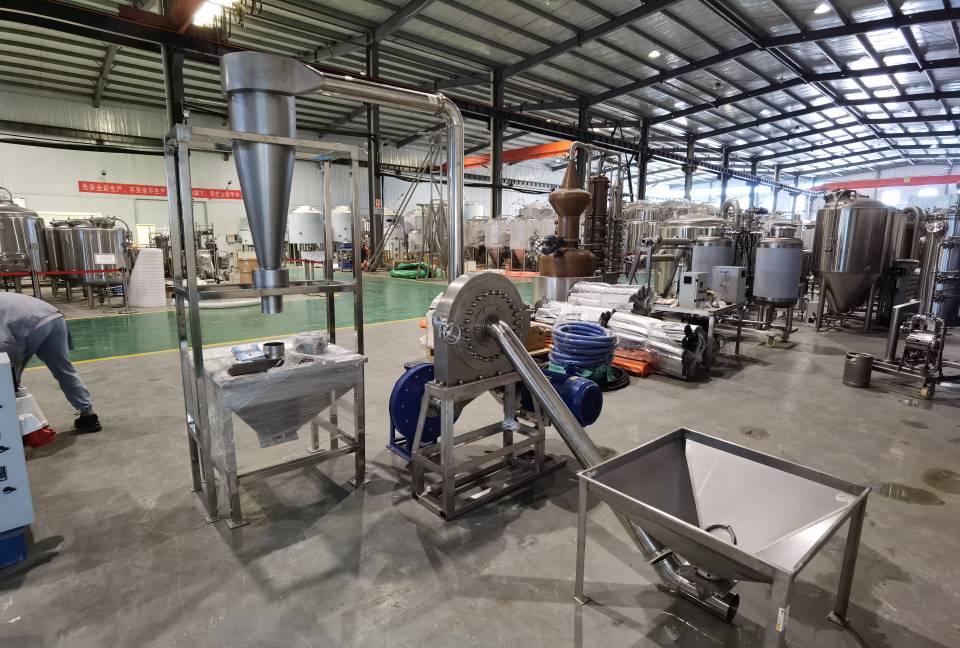
Many distilleries prefer claw mills (also called pin mills or impact mills).
A claw mill uses high-speed rotating teeth or claws to strike and crush the grain kernels. Instead of gently cracking the grain like a roller mill, the claws break the grain through impact and friction.
Typical particle size after milling: 0.5 mm – 1.2 mm
This results in a much finer and more uniform powder compared with roller milling.
Why Distilleries Use Finer Milling
Unlike breweries, distilleries usually do not need to filter the mash before fermentation.
In many distillation processes, the mash containing fine particles is transferred directly to fermentation tanks. This is often called grain-in fermentation.
Because filtration is not required, distilleries can benefit from finer particle sizes, which provide several advantages:
*Larger surface area for enzyme activity
*Faster starch conversion
*Higher sugar extraction efficiency
*Potentially higher alcohol yield
*For these reasons, finer milling is often preferred in distillery production.
Equipment Design Differences
Another important difference between roller mills and claw mills lies in their mechanical design.
Roller mills generally feature:
**Two or four hardened steel rollers
**Adjustable roller gap
**Lower rotational speed
**Gentle crushing action
They are designed primarily for precision and husk protection, rather than maximum grinding force.
Claw Mill Characteristics
Claw mills are designed for heavy-duty grinding applications.
They typically include:
**High-speed rotating claw discs
**Impact-based crushing mechanism
**Replaceable wear parts
**High-power motors
Because of the stronger mechanical structure and higher energy consumption, claw mills are often more expensive than roller mills, especially in industrial-scale applications.
When to Choose Each Type
The choice of grain mill depends largely on the production process.
Roller Mills Are Ideal For
Craft breweries
Industrial breweries
Systems requiring lauter tuns
Malt-based beer production
Claw Mills Are Ideal For
Distilleries producing whisky or grain spirits
Systems using unmalted grains
Processes requiring fine particle sizes
High-efficiency starch conversion
Conclusion
Although both breweries and distilleries rely on grain milling, their equipment choices reflect different production priorities.
Breweries prioritize lautering performance and husk integrity, which makes roller mills the preferred choice.
Distilleries focus on maximum starch exposure and conversion efficiency, which often leads to the use of claw mills or other impact-style mills.
Despite being less common in breweries, claw mills are typically more expensive due to their stronger mechanical structure and higher power requirements, making them well suited for demanding distillery applications.
Selecting the right milling system is essential for optimizing mash efficiency, fermentation performance, and overall production results.
Email: [email protected]
Sales manager of Tiantai beer equipment co
This article explains the key differences between brewery grain mills and distillery grain mills, including their working principles, advantages, and typical applications.
Grain Milling in Breweries
Typical Mill Type: Roller Mill
Most breweries use two-roller or four-roller mills to crush malted barley.
The principle of a roller mill is simple: two rollers rotate toward each other and gently crack the grain kernel. The goal is not to completely pulverize the grain but to break the kernel while preserving the husk.
Typical particle size after milling: 1.2 mm – 2 mm
Why Breweries Use Roller Mills
In beer production, the milled grain must pass through a lautering stage, where the grain bed acts as a natural filter.
If the grain is ground too finely, the mash may become compact and block the filter bed.
Roller mills therefore offer several advantages for brewing:
*Preserve the grain husk structure
*Produce a consistent coarse grist
*Improve lautering performance
*Reduce excessive flour generation
Because of these characteristics, roller mills are widely used in breweries around the world.
Grain Milling in Distilleries
Typical Mill Type: Claw Mill
Many distilleries prefer claw mills (also called pin mills or impact mills).
A claw mill uses high-speed rotating teeth or claws to strike and crush the grain kernels. Instead of gently cracking the grain like a roller mill, the claws break the grain through impact and friction.
Typical particle size after milling: 0.5 mm – 1.2 mm
This results in a much finer and more uniform powder compared with roller milling.
Why Distilleries Use Finer Milling
Unlike breweries, distilleries usually do not need to filter the mash before fermentation.
In many distillation processes, the mash containing fine particles is transferred directly to fermentation tanks. This is often called grain-in fermentation.
Because filtration is not required, distilleries can benefit from finer particle sizes, which provide several advantages:
*Larger surface area for enzyme activity
*Faster starch conversion
*Higher sugar extraction efficiency
*Potentially higher alcohol yield
*For these reasons, finer milling is often preferred in distillery production.
Equipment Design Differences
Another important difference between roller mills and claw mills lies in their mechanical design.
Roller mills generally feature:
**Two or four hardened steel rollers
**Adjustable roller gap
**Lower rotational speed
**Gentle crushing action
They are designed primarily for precision and husk protection, rather than maximum grinding force.
Claw Mill Characteristics
Claw mills are designed for heavy-duty grinding applications.
They typically include:
**High-speed rotating claw discs
**Impact-based crushing mechanism
**Replaceable wear parts
**High-power motors
Because of the stronger mechanical structure and higher energy consumption, claw mills are often more expensive than roller mills, especially in industrial-scale applications.
Comparison of Roller Mills and Claw Mills
| Feature | Roller Mill | Claw Mill |
| Grinding principle | Compression between rollers | High-speed impact crushing |
| Typical particle size | 1.2–2 mm | 0.5–1.2 mm |
| Husk preservation | Excellent | Limited |
| Flour content | Low | Higher |
| Filtration suitability | Ideal for lautering | Not suitable for lautering |
| Typical industry | Brewing | Distilling |
| Equipment strength | Moderate | Heavy-duty |
| Typical equipment cost | Lower | Higher |
When to Choose Each Type
The choice of grain mill depends largely on the production process.
Roller Mills Are Ideal For
Craft breweries
Industrial breweries
Systems requiring lauter tuns
Malt-based beer production
Claw Mills Are Ideal For
Distilleries producing whisky or grain spirits
Systems using unmalted grains
Processes requiring fine particle sizes
High-efficiency starch conversion
Conclusion
Although both breweries and distilleries rely on grain milling, their equipment choices reflect different production priorities.
Breweries prioritize lautering performance and husk integrity, which makes roller mills the preferred choice.
Distilleries focus on maximum starch exposure and conversion efficiency, which often leads to the use of claw mills or other impact-style mills.
Despite being less common in breweries, claw mills are typically more expensive due to their stronger mechanical structure and higher power requirements, making them well suited for demanding distillery applications.
Selecting the right milling system is essential for optimizing mash efficiency, fermentation performance, and overall production results.
Email: [email protected]
Sales manager of Tiantai beer equipment co


.jpg)